Demurrage records, verified and exchanged
One demurrage record both sides can trust, from the systems you already use.
Demurly takes waits from your EDI, your own system or our driver app if you need one, checks the GPS, photos and times, and delivers the charge into your customer's accounting system, by EDI or to their inbox. No new platform for anyone to adopt.
- Your customers never need a Demurly account
- Unlimited drivers at no cost, on every plan
94.5%
of fleets charge detention fees
<50%
of those invoices are paid
39.3%
of stops, drivers reported being detained
135M+
hours lost to detention in 2023
Across US for-hire trucking, not fuel hauling alone. 2023 data. American Transportation Research Institute, 2024
The problem
Why demurrage turns into an argument
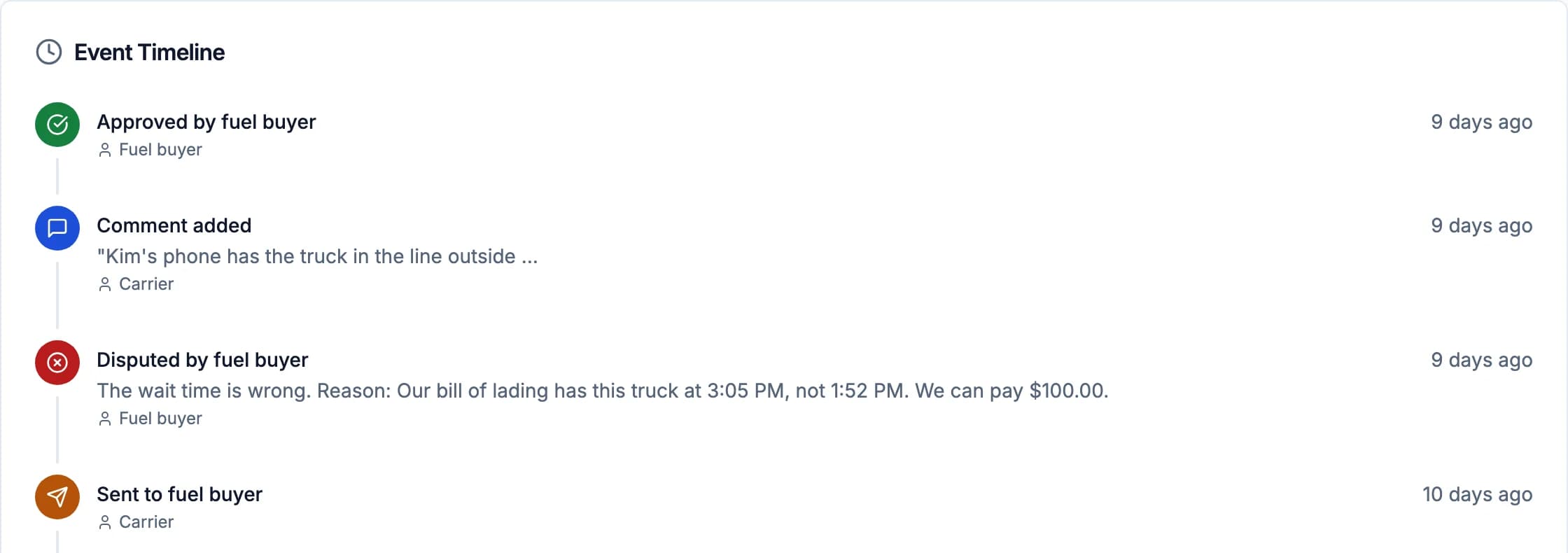
Nearly every fleet charges for detention, and across trucking they're paid on fewer than half of those invoices. The fight is almost always about proof. The video follows one wait at the rack: the argument over when it started, then the same wait on Demurly.
Paper and email
The old way
- Carrier bills from the driver's log
- 1:52 PM → $225.00
- Buyer goes by the bill of lading
- 3:05 PM → $100.00
- In line before the bill of lading
- 1h 13m, on neither paper
14 emails. 3 weeks. Still unpaid.
One record both sides see
The Demurly way
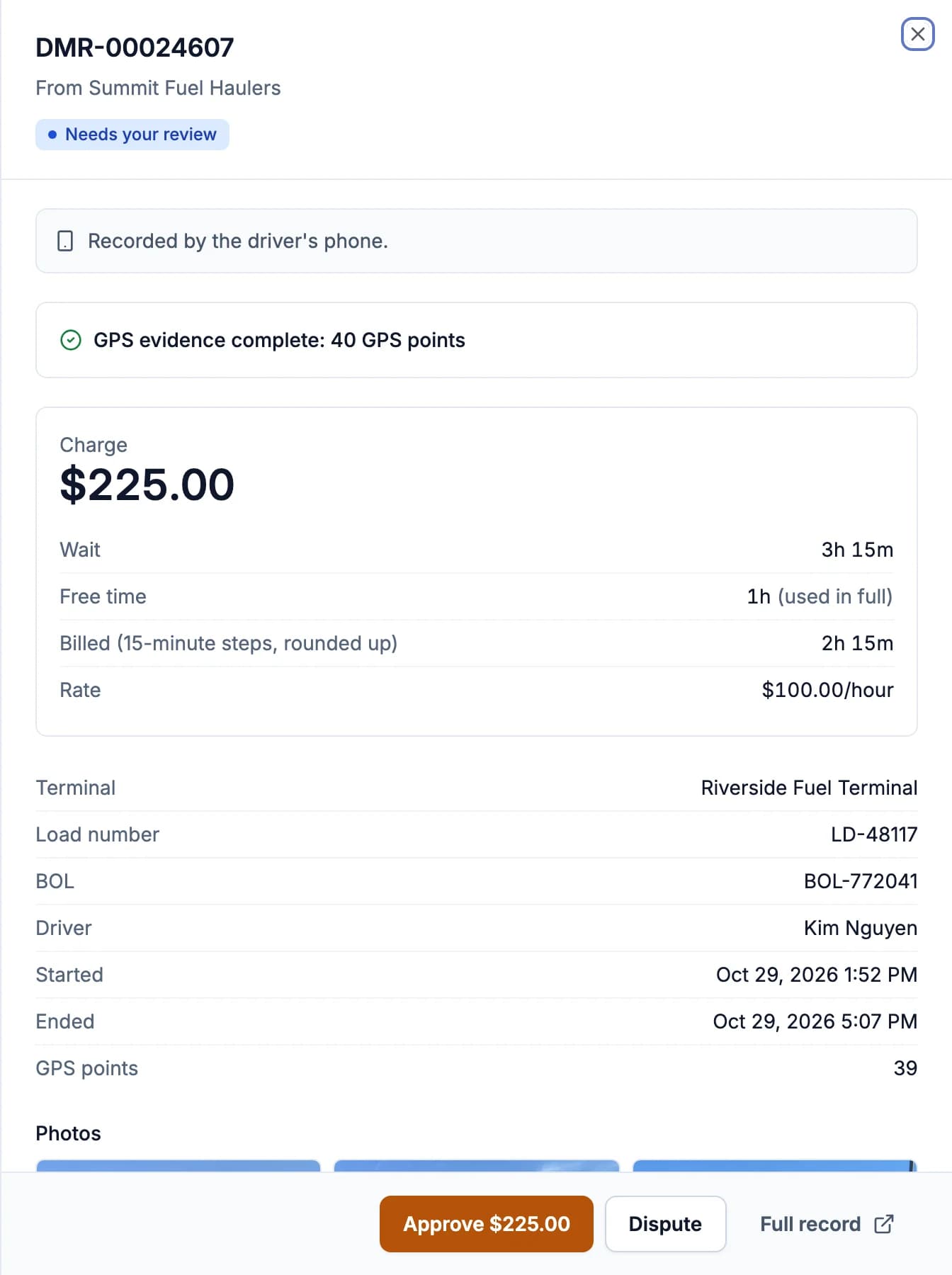
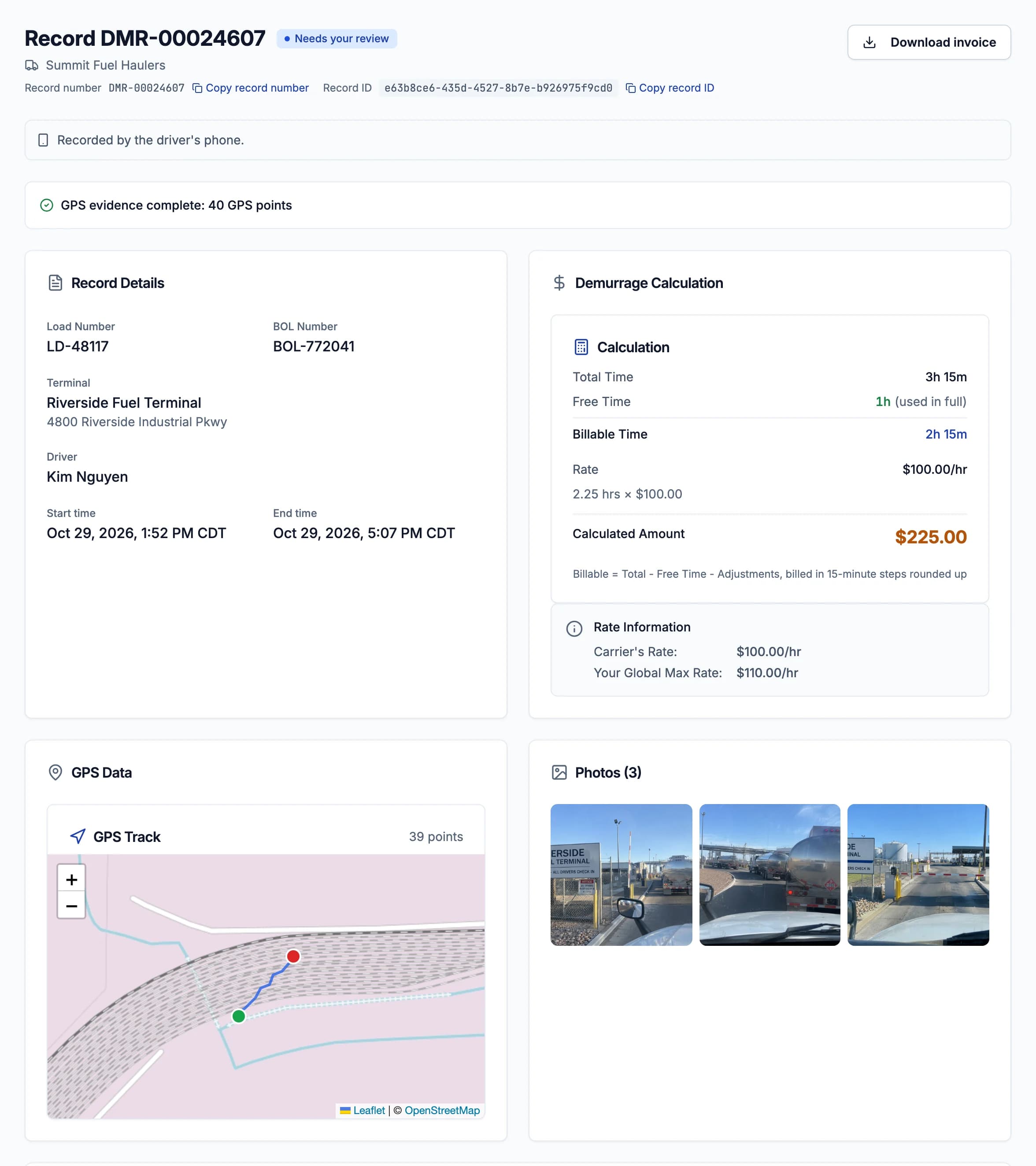
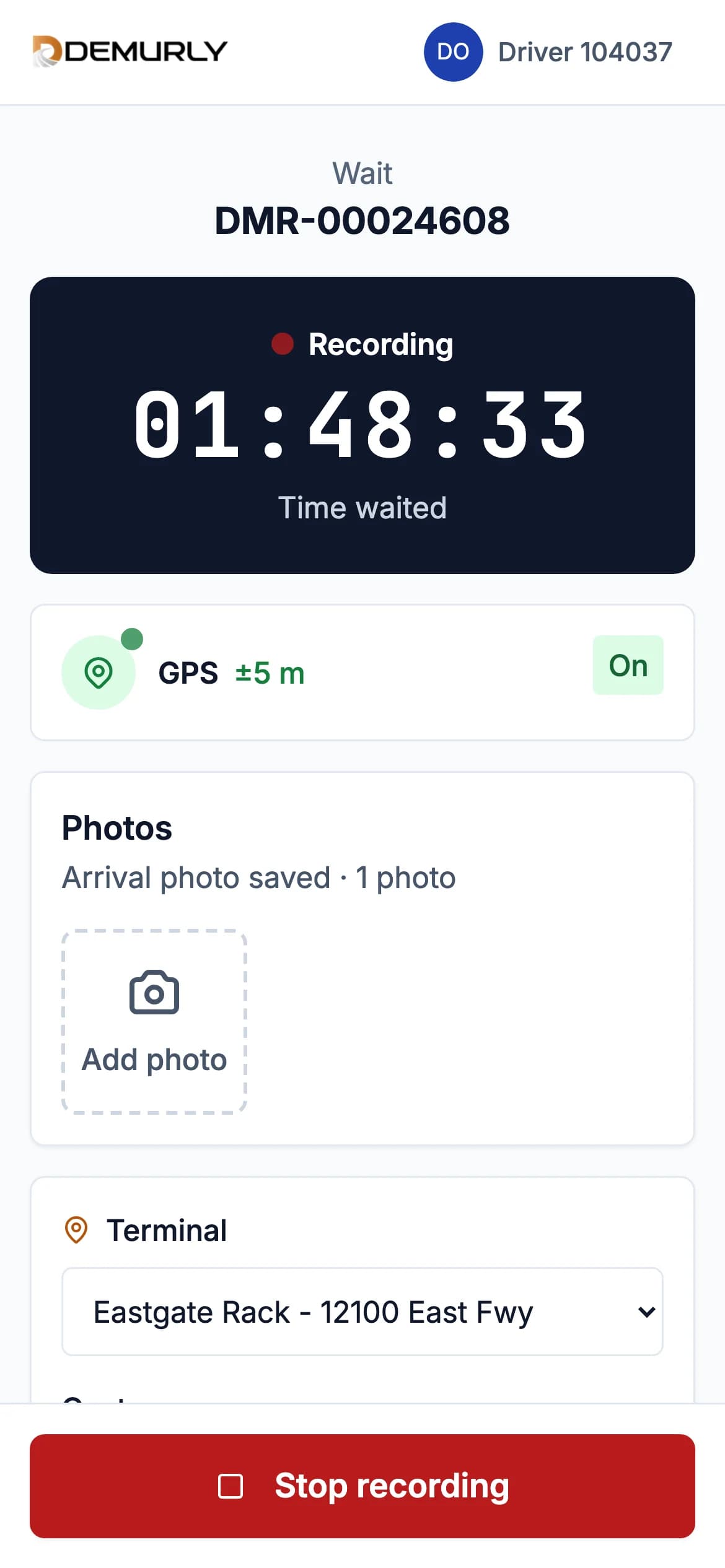
- 1:52 PMThe driver taps Start in line; GPS starts
- 1:58 PMPhoto of the line at Gate 2
- 3:05 PMGPS: through the gate. The bill of lading starts here
- 5:07 PMStops by itself as the truck drives off
3h 15m − 1h free = 2h 15m billable × $100.00/hr = $225.00
Dispatch checks it and sends it. The buyer sees the same record, where the truck was and what the driver saw, and approves $225.00. Paid.
What it costs
Put your own numbers on it
One disputed wait is a hundred dollars and an afternoon of emails. Across a year of loads it's a line on the P&L. Set the sliders to your operation and see what the argument costs.
Across US trucking, ATRI found fleets are paid for fewer than half of the detention invoices they send.
$117,000
of wait time billed a year that never gets paid
- Waits a year
- 2,340
- Billed per wait
- $100
- Billable a year
- $234,000
- Unpaid per truck
- $4,680
Your numbers, the math as live formulas, and a what-if table to share with your team.
An estimate from the numbers you set, to show what's at stake. It isn't what Demurly would recover: a record makes the wait provable, and paying it is still between you and the other company.
One record, any system
How Demurly settles it
One record follows the wait from wherever it was recorded to wherever it's paid, checked the same way on the way through. Nobody changes the systems they use.
Wherever the wait is recorded
It comes in from what you already run
- An EDI 214 opens and closes it
- Your own system sends it through the API
- Or the driver taps Start in our app, if you need one
- Every record says where it came from
Before anyone sees a bill
It's checked the same way every time
- The GPS trail against the terminal's outline
- Photos checked for copies, edits, time and place
- Your rate and free time, and the buyer's terms
- Billed in 15-minute steps, the same way every time
Where the fuel buyer works
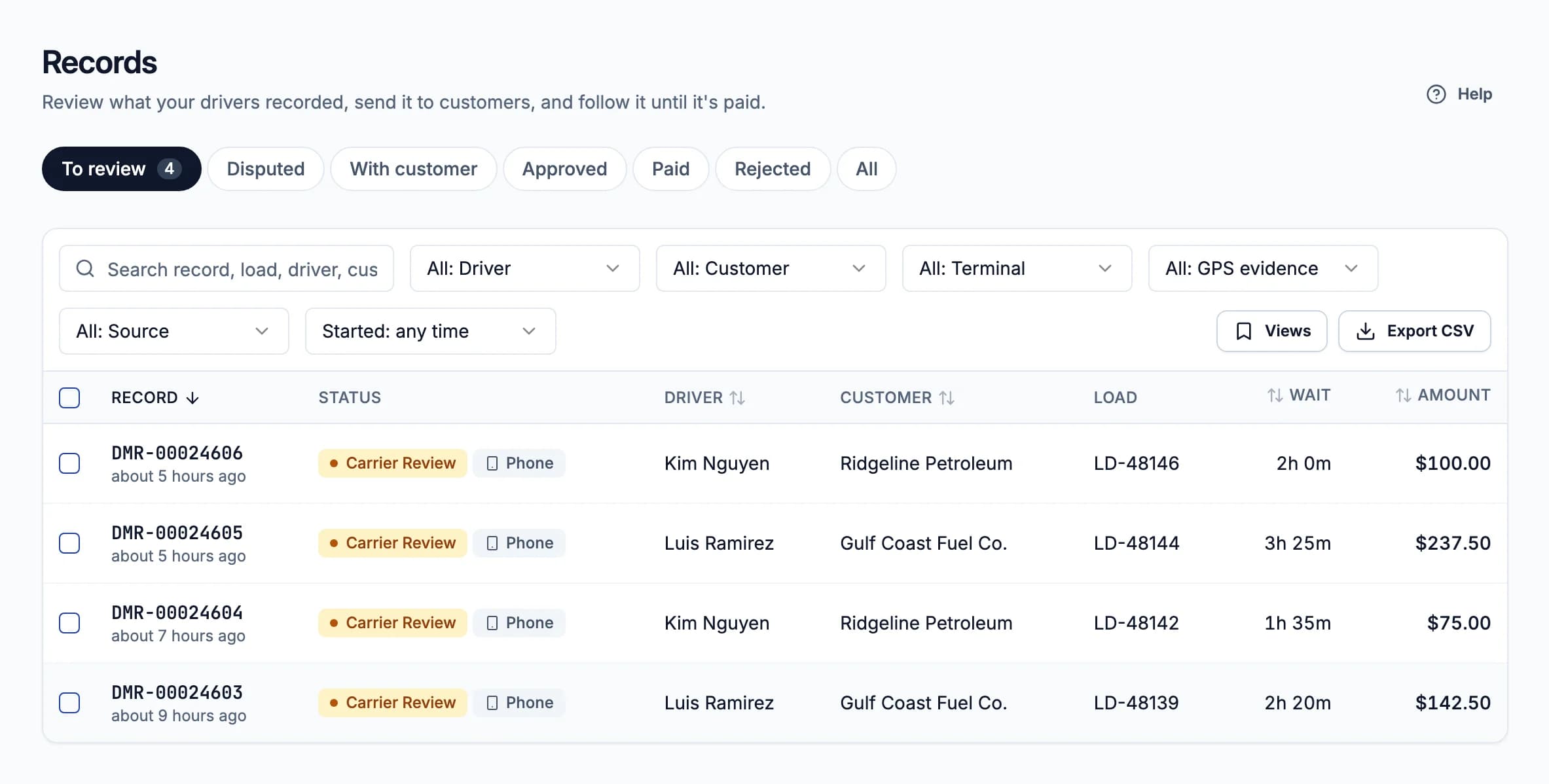
It lands in the buyer's own systems
- A bill in their QuickBooks, NetSuite or SAP (early access)
- Or an emailed review link: no account needed
- Times, GPS trail, photos and the math, the same as the carrier sees
- An EDI 210 invoice once it's approved
When they disagree
Disputes and payments stay on one record
- A dispute and its answer stay on the record
- The history can't be edited after the fact
- Approved after a dispute, it's billed like any other

Works with
It fits the systems you already run
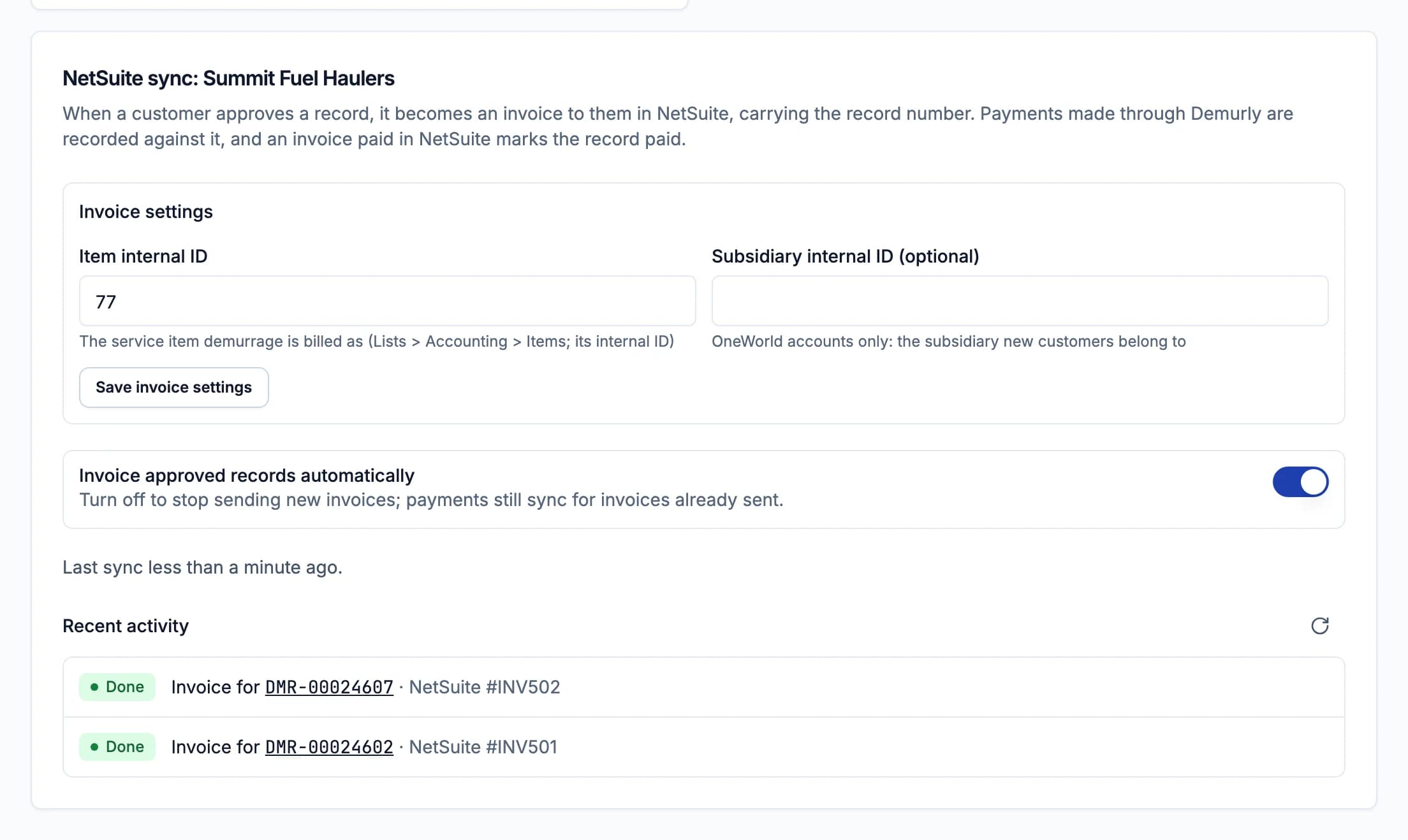
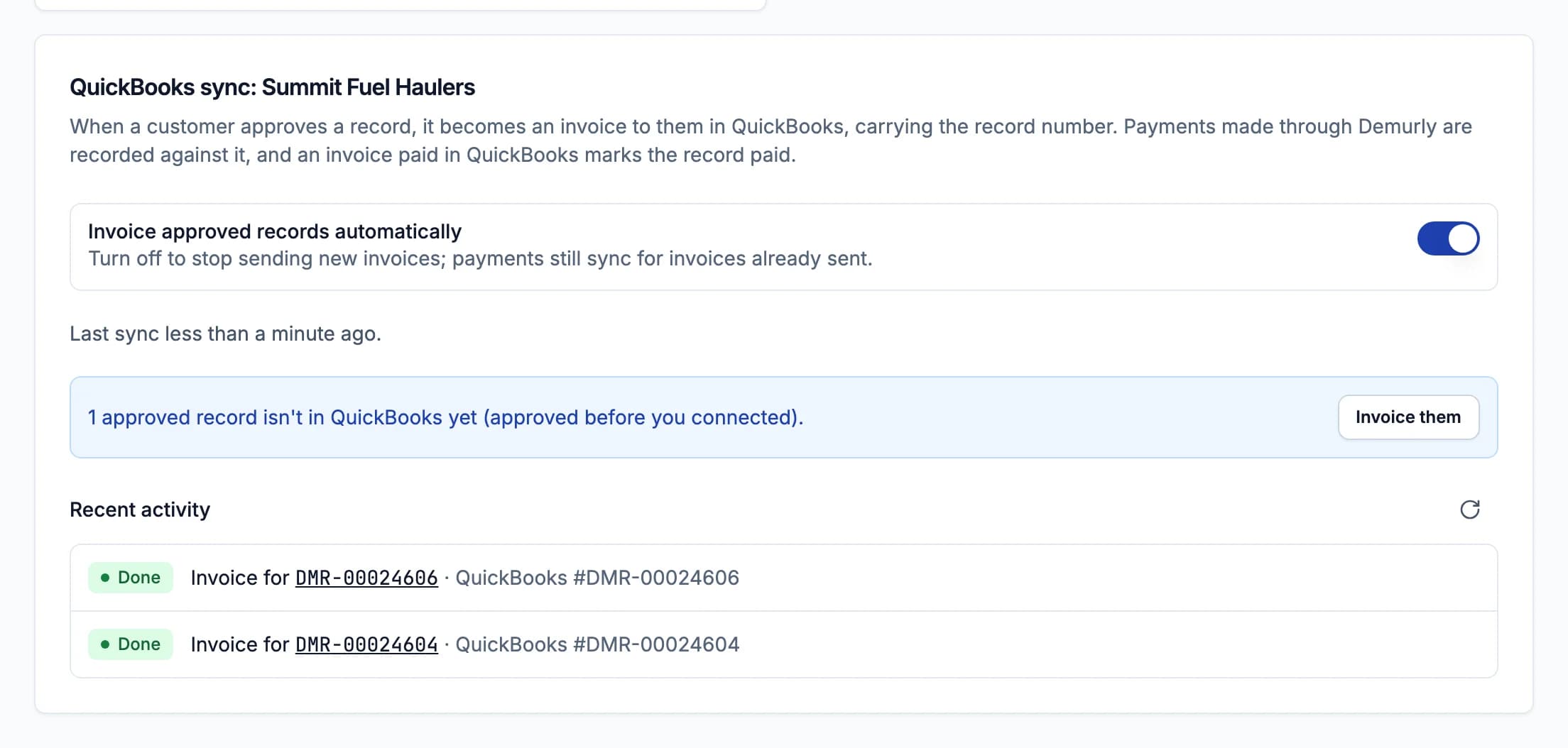
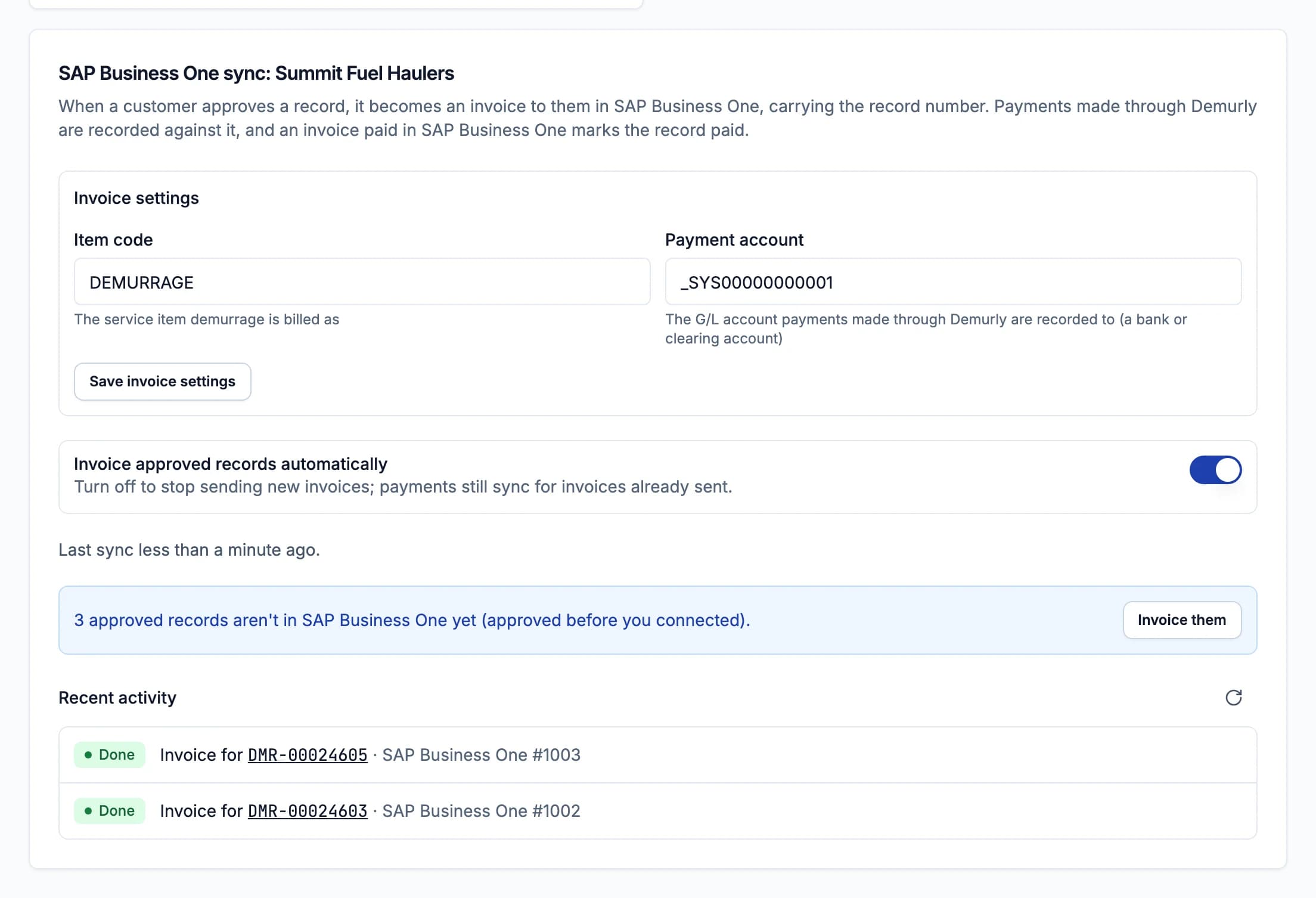
Approved: the charge lands in the carrier's books as an invoice and in the buyer's as a bill.
Paid: a payment made in Demurly, or in either company's books, comes back and marks the record paid for both. A bill paid in the buyer's books shows as paid outside Demurly until the carrier confirms it or the carrier's books show it.
Carriers' books
QuickBooks Online, NetSuite, SAP Business One, or PDI Enterprise by import file (early access, Pro): each approved charge becomes an invoice, a receivable in your books. A payment made in Demurly is posted to it, and an invoice paid in your books marks the record paid.
Buyers' books
The same four systems, free (early access): each approved charge becomes a bill, a payable in your books, under the vendor you map the carrier to. Pay it in Demurly and the bill payment is recorded; pay the bill in your books and the carrier sees it paid outside Demurly, to confirm. Or take approved charges as a CSV on your schedule.
Your trading partners
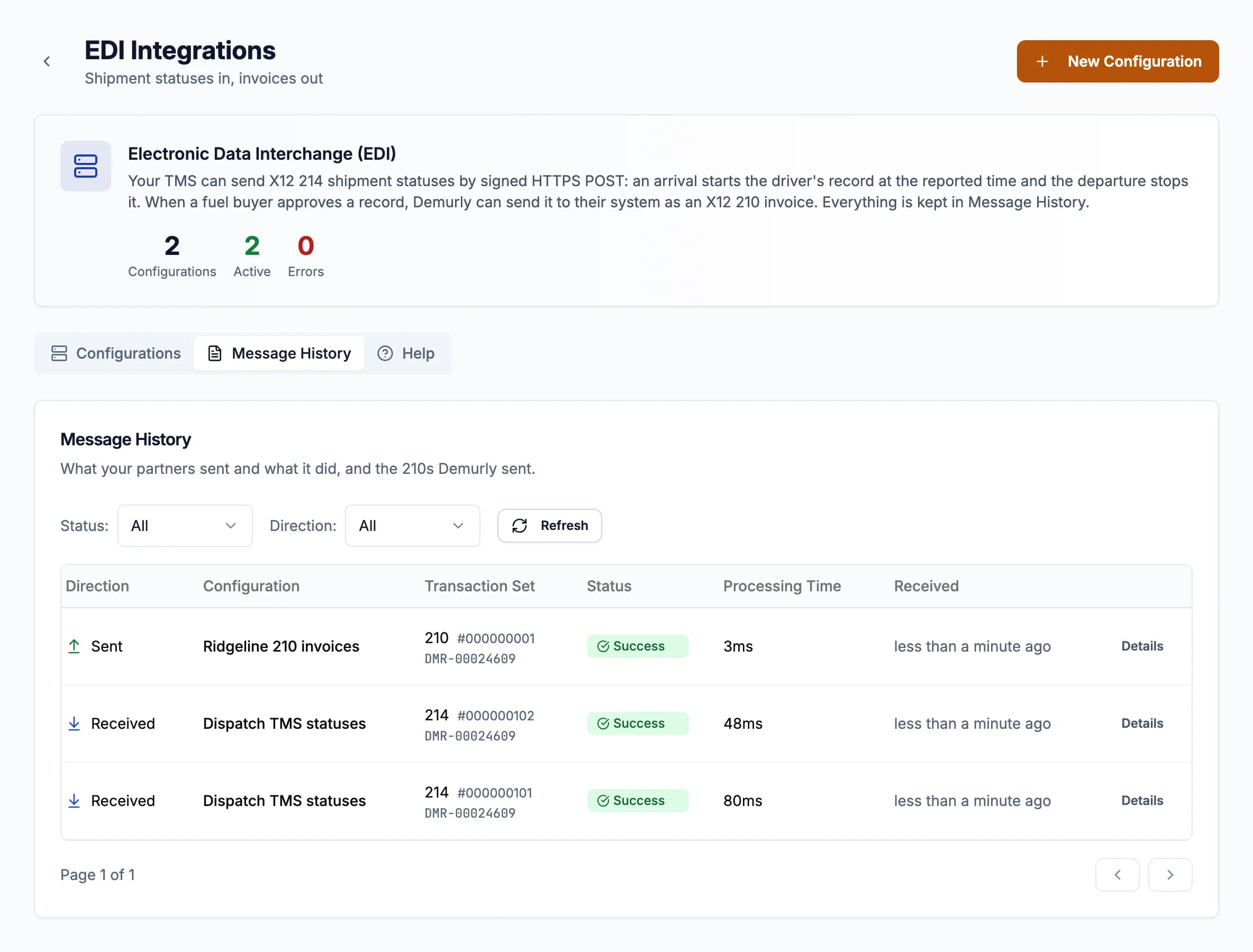
EDI X12: incoming 214s start and stop records, and approved charges go out as 210s.
Your rules
Single sign-on (SAML), approval limits by role, and an audit log of every change.
Your own systems
A REST API and signed webhooks, documented from the same file the app is tested against.
Your trucks' ELD
Samsara and Motive, coming for Pro carriers: the truck's own GPS opens and closes the record at terminals and customer sites.
 Oracle NetSuite


- EDI X12
- REST API
 Coming
 Coming
Who it's for
One record, three jobs
Fuel Buyer
Approve what's real. Dispute what isn't.
- No account needed: review a charge from an emailed link
- Every charge arrives with its GPS trail and photos
- Approved charges as bills in your books, or a scheduled CSV
Free to use
Invite your carriersCarrier
Bill every wait you can prove.
- Waits from your EDI, your own system, or our driver app
- Charges worked out from your rate and free time
- Invoices in your books, or paid by card in Demurly
No subscription; first 25 approved charges free
Start freeDriver
Tap when you arrive. Tap when you leave.
- Works in your phone's browser, nothing to install
- Sign in with the company code, driver number and PIN from your carrier
- Keeps your times even when the signal drops
Set up by your carrier
Driver sign-inComing for Samsara and Motive fleets
Next, the truck proves the wait by itself
Most fuel fleets already run Samsara or Motive. Connect yours and Demurly reads the truck's own GPS: when it pulls into a terminal or a customer's site, a record opens; when it drives off, the record closes with the trail attached. The road-facing dashcam adds the photo of the line. Your driver confirms the bill of lading number in the ELD app they already use: no second app, no Start button to forget.
- Arrival and departure from the truck's gateway, not anyone's memory
- The fuel buyer is warned before free time runs out
- A dashcam photo of the line on the record
- The same review, approval and payment you use today
For Pro carriers. In development now.
Truck 214 · Oct 29
Coming1:52 PM
Truck 214 entered Riverside Fuel Terminal
Samsara gateway · record DMR-00000614 opened
1:58 PM
Dashcam photo of the line
Road-facing camera, on the record
2:52 PM
Free time ends
Ridgeline Petroleum notified while the truck is still there
5:07 PM
Left the terminal
Record closed · 3h 15m · $225.00
Pricing
Pay when your charge is approved
Add every driver you have, at no cost, on every plan. Fuel buyers use Demurly for free. Carriers pay no subscription: just a fee on each charge the buyer approves, and the first 25 are free.
Standard: no monthly fee
3% of each approved charge, at least $3 and at most $30, however the buyer pays it: in Demurly, or by check, ACH or wire. Nothing on charges that are rejected or never approved. Your first 25 approved charges are free.
Pro: $199 a month
1.5% of each approved charge, at least $1.50 and at most $15, plus:
- Accounting sync: QuickBooks Online, NetSuite, SAP Business One, and PDI Enterprise by import file
- EDI 214 status messages in and 210 invoices out
- The public API and webhooks
- Unlimited saved reports, scheduled reports and the BI feed
Fees on charges paid in Demurly come out of the payout; the rest are billed once a month.
Example: a $150 charge paid by card
- The charge
- $150
- Card processing, shown to the buyer before paying
- $4.79
- The buyer pays
- $154.79
- Demurly fee (3%), from the carrier's payout
- $4.50
- The carrier receives
- $145.50
Buyers who pay by check, ACH or through their own books mark the charge paid; no card fee applies, and the carrier's 3% fee is billed with the month's others.
Questions people ask
Do we have to switch systems, or log in to another portal?
No. Demurly sits between the systems you already use. A carrier's waits can come in by EDI 214 or through the API from its own system, and the driver app is there only if you have no way to record waits. A fuel buyer can review and approve from an emailed link with no account, get approved charges as bills in QuickBooks, NetSuite or SAP Business One (early access), or as a scheduled CSV. Every record is checked the same way, whichever way it came in. What it connects to
Do I need an account to approve a charge?
No. When a carrier sends you a charge, the email has a link to it. If it went to your company email address, you can review the times, photos and GPS check and approve or dispute from that link. The GPS map and your full list of charges are in a free account, which you can create later from the same link.
How do I check an invoice is genuine?
Every Demurly invoice carries its record number and a verification code. Enter them at demurly.com/verify, with no account, to check the invoice matches Demurly's record: the times, the amount, the GPS check and the photos. If anything changed after the invoice was made, or the invoice was altered, it won't match. Verify a record
What if my carrier and I disagree on free time?
Each record shows the free time and rate that were applied, set by the carrier for your account. If it's wrong, dispute it with a reason. The carrier can correct the record and send it again, and every change stays in its history.
Who sees the photos and GPS?
The carrier's team and the fuel buyer the charge is sent to. Location is only logged while a wait is being recorded.
Can a record be changed after it's sent?
Details can be corrected and the record sent again, but nothing is overwritten: the history shows every step, who took it and when, and it can't be edited.
Do terminals have to use Demurly?
No. The wait comes from the carrier's side: its EDI, its own system, or the driver's phone. The terminal doesn't need to do anything.
Is detention the same as demurrage?
Close enough for this. In trucking, detention usually means paying a carrier for time its truck is held beyond the free time. In fuel hauling, the same charge is often called demurrage. Demurly handles that charge, whatever you call it.
How is the evidence handled?
Only the two companies on a charge see its GPS trail and photos: the carrier's team and the fuel buyer it's sent to. The phone logs location only while a wait is being recorded, never through the rest of the day. Every step, from the driver's first tap to payment, stays in the record's history as it happened, and no one can edit it. Records are kept for seven years, like any financial record, so an audit years from now still has the proof behind each charge. Demurly LLC is a US company, hosted on US servers; payments go through Stripe, and two-step sign-in is available to everyone.
Who built Demurly?
Demurly's founder comes from fuel distribution: managing hundreds of drivers and carriers, with over a billion gallons a year delivered on the company's own trucks and through third-party carriers. That's both sides of the charge: sending the detention invoice, and being asked to pay one. Questions, or want to try it on your own lanes first? Book a 15-minute call or contact us; you'll talk to a person, not a sales script.
Do you work with Samsara or Motive?
Not yet: it's in development for Pro carriers. Once your Samsara or Motive account is connected, the truck's own GPS opens a record when it pulls into a terminal or a customer's site and closes it when it drives off, with the trail and a dashcam photo of the line, and your driver confirms the bill of lading number in the ELD app they already use. We're building it with pilot carriers now. Become a pilot carrier
Will approved charges show up in our books?
Yes, with QuickBooks Online, NetSuite, SAP Business One, or PDI Enterprise by import file, on both sides (early access). When the buyer approves a charge, it becomes an invoice in the carrier's books and a bill in the buyer's. A payment made in Demurly is recorded in both. An invoice paid in the carrier's books marks the record paid; a bill paid in the buyer's books marks it paid outside Demurly, for the carrier to confirm. It's part of Pro for carriers and free for fuel buyers. How the accounting sync works
What does it cost?
Fuel buyers use Demurly for free. Carriers add unlimited drivers at no cost on every plan, and pay no subscription: 3% of each approved charge, at least $3 and at most $30, however the buyer pays it, due when the buyer approves the charge, and nothing on charges that are rejected or never approved. A carrier's first 25 approved charges are free. Pro ($199 a month) lowers the fee to 1.5% and adds accounting sync, EDI, the API and unlimited saved and scheduled reports. Enterprise is $999 a month (or $9,990 a year) and lowers the fee to 1% of each approved charge, at least $1 and at most $15; larger operations can sign an annual contract with volume pricing. Card and bank payments add a processing fee for the buyer, shown before paying.